
A journey through Senegal, plastic waste, language, wrestling, and the strange way purpose sometimes finds a person before he knows he is looking for it.
When Niklas Bruggeman first arrived in Senegal, he came for the waves.
He was young, between school and university, and standing in that loose, uncertain space many young people know well: old enough to leave home, not yet old enough to know exactly where home is supposed to be. He had grown up in Zurich, Switzerland, a place where systems work, streets are clean, waste is collected, and environmental responsibility is taught so early that it can become almost invisible. You throw things in the bin because there is a bin. You recycle because recycling exists. You learn about the planet in school because someone made sure it was part of the curriculum.
Senegal did not meet him that way.
He came in April 2024 on what was supposed to be a surfing trip. The waves were good, even unforgettable. But what caught him more deeply was not the ocean. It was the country behind it. It was the way people spoke to each other, the way neighborhoods seemed to breathe, the way strangers became part of the day. It was the culture, the people, the rhythm of a place that felt unfamiliar but strangely open.
At first, he was still outside of it. He did not speak much French. He did not speak Wolof. He was a visitor watching the life around him happen in a language he could not yet enter. Then he learned a few words. Something small shifted. Then something much larger opened.
“As soon as I learned one word in Wolof, everything flowed. Everything opened up.”
Niklas Bruggeman That line says almost everything about what happened to him next.
For many travelers, language is a tool. For Niklas, it became a doorway. The more he learned, the less Senegal remained a place he was passing through. People responded differently. The community changed around him, or maybe he changed enough to finally see it. He began to understand that culture is not something you observe from a distance if you want to truly know it. You have to risk looking foolish. You have to mispronounce things. You have to ask. You have to listen. You have to accept that you do not know.
Before he ever became involved with the environmental work of the man known as the Plastic Man, Senegal had already begun to alter him. It gave him something he had not expected from a surf trip: a sense of belonging that did not come from comfort, but from participation.
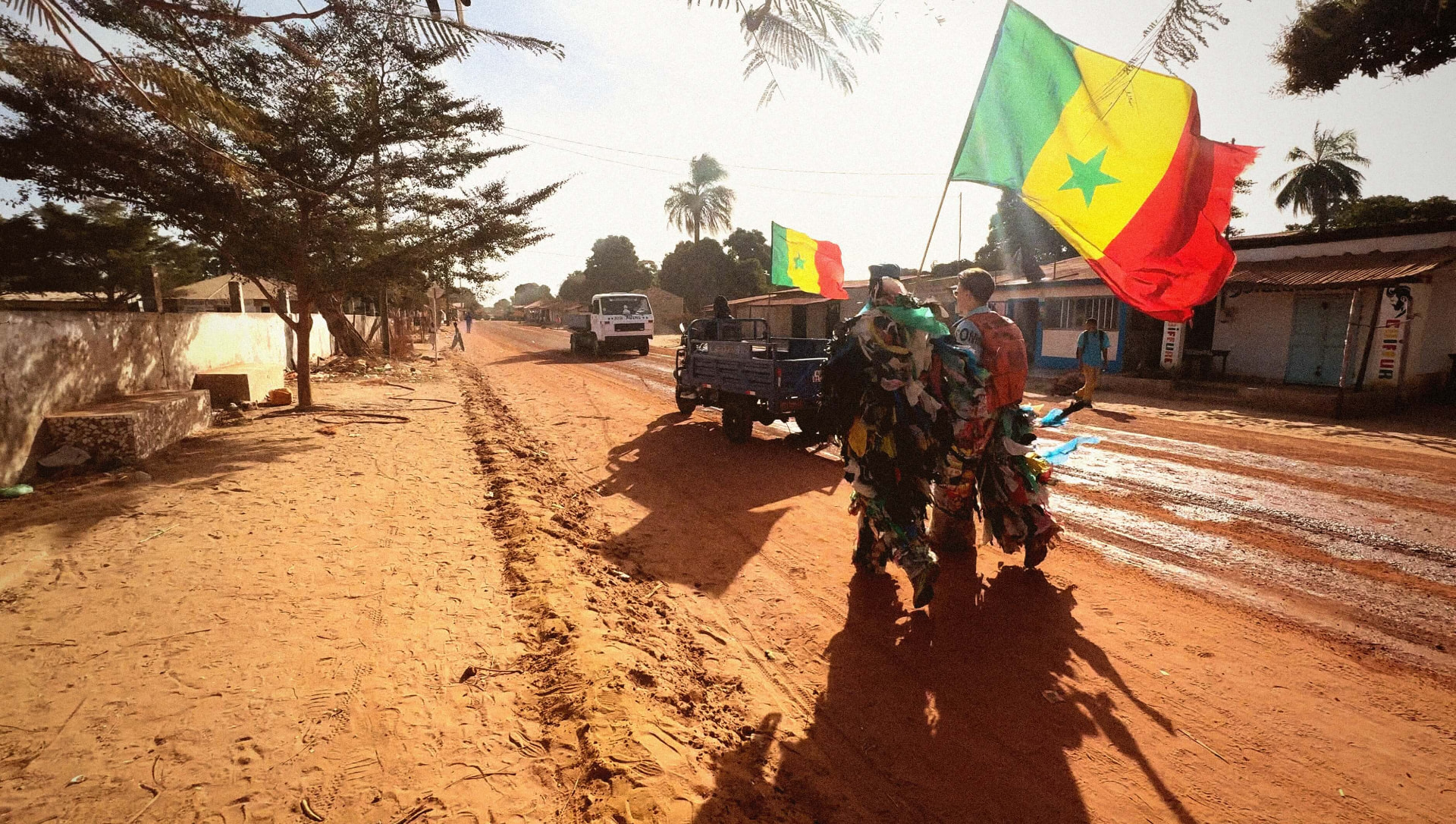
The Plastic Man walks a dirt road draped in plastic waste, flags overhead. A surf trip became something else entirely, Senegal began to alter him before the work ever started. The first fascination was surfing. The second was Senegalese wrestling.
Laamb, the national sport of Senegal, is not just a sport in the Western sense. It carries ceremony, strength, music, spirituality, pride, and neighborhood identity. To an outsider, it can look like spectacle. To those inside it, it is history and community performed with the body. Niklas became drawn to it, not casually, but intensely enough that he decided to return to Senegal eight months later to make a documentary about it.
That decision matters. It marks the first moment where he stopped being simply a traveler and started becoming a storyteller. He had been to Senegal, loved it, gone home, and then decided to come back with intention. He wanted to make something. He wanted to understand something. He wanted to follow a thread that had caught him.
In November 2024, while pursuing that thread, he met another.
His name is Moudou Fall, though many know him as the Plastic Man.
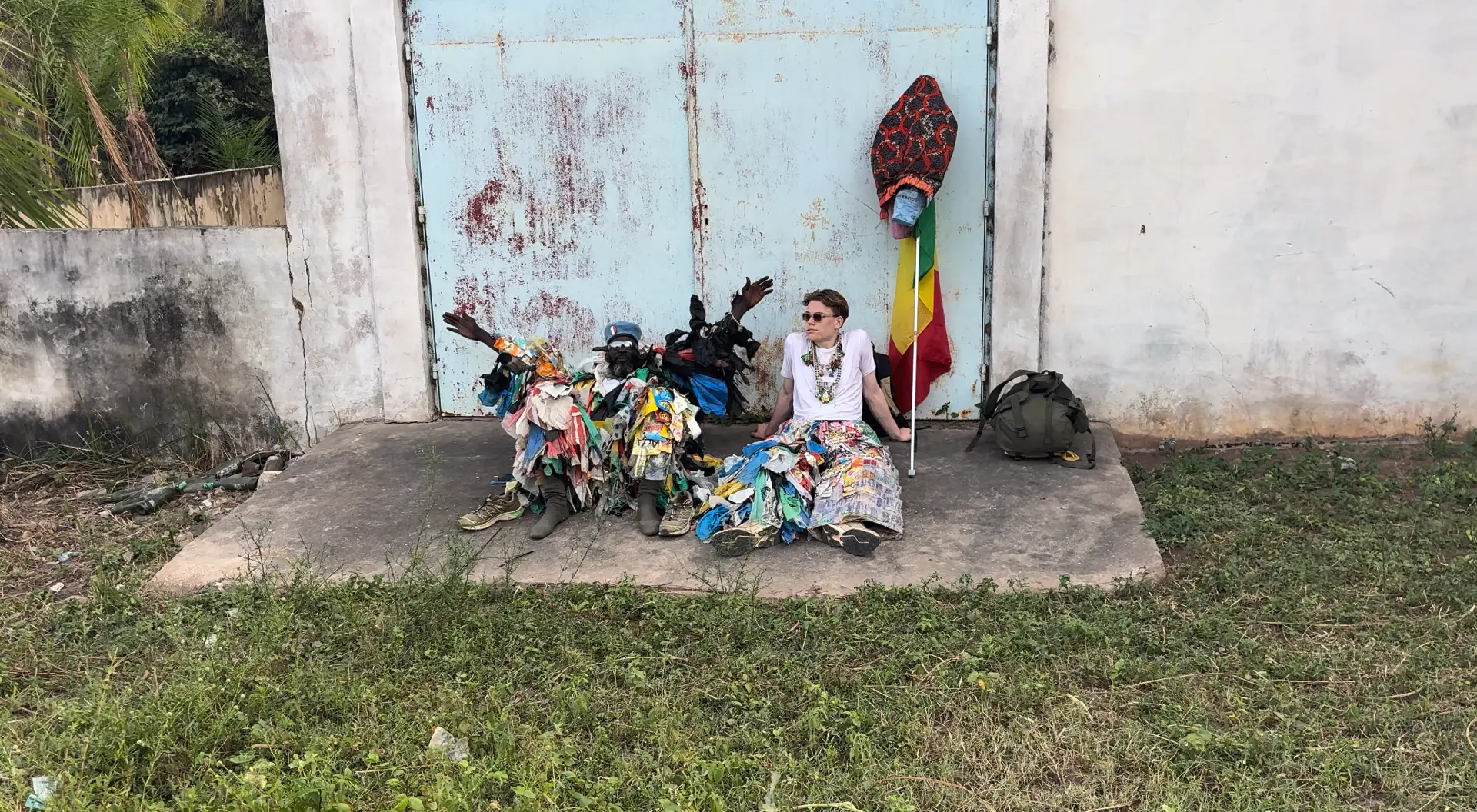
Moudou Fall, the Plastic Man, covered in collected plastic waste. Moudou Fall becomes the problem, visibly and physically, turning pollution into a character people cannot look away from. Moudou is 53 years old and has spent nearly two decades fighting for Senegal’s environment. His method is almost impossible to ignore. He dresses in a large, colorful costume made from plastic bags and plastic waste collected from beaches, streets, and daily life. He walks through public spaces covered in the very material he is trying to warn people about. He becomes the problem, visibly and physically. He turns waste into a body. He turns pollution into a character people cannot look away from.
In another context, the costume might be mistaken for theater. In Senegal, it is activism sharpened into an image.
Since 2006, Moudou has dedicated his life to this work. What started as one man walking around in a costume eventually brought media attention, invitations to events, political attention, and the creation of his organization, Senegal Pro. But at its core, the work remains deeply simple. He walks. He talks. He makes noise. He educates. He goes where people are and asks them to see what is already around them.
For Niklas, meeting him changed everything.
He had come back to Senegal to make a film about wrestling. Instead, he found himself drawn into the life of a man who had given up ordinary comfort for a mission that most people would rather avoid.
There is a powerful contrast between them. Niklas comes from a world where the plastic problem exists, but is often hidden by infrastructure. Waste disappears into systems. The bin is emptied. The bottle is recycled. The street is cleaned. The consequence is moved somewhere else. In that kind of world, environmental awareness can become abstract. It is real, but it is managed. It is serious, but not always visible.
Moudou lives inside a different reality. In parts of Senegal, waste does not disappear. It stays. It gathers in streets, beaches, neighborhoods, and open spaces. It burns. It breaks apart. It becomes part of the landscape. The issue is not only individual behavior. It is education, infrastructure, poverty, government investment, and a global consumer culture that leaves its evidence most brutally in places least equipped to process it.
Niklas understood this difference quickly, but not in a superior way. In fact, one of the most human parts of his reflection is that he had to keep reminding himself that the assumptions he brought from Europe did not automatically apply.
In Switzerland, he grew up knowing to throw trash in a trash bin. But what happens if there is no trash bin? What happens if nobody has explained what happens to a plastic bag after it leaves your hand? What happens if burning plastic seems like the only available way to get rid of it? What happens if the structure around you has never made environmental responsibility practical?
This is where the story deepens. It is not about a young European going to Africa to teach people how to live. Niklas himself seems aware of the danger of that kind of story. He fell in love with Senegal before he tried to work there. He learned the language. He learned the culture. He learned the sport. He lived in neighborhoods that outsiders warned him against. He allowed himself to be welcomed before he tried to be useful.
That difference matters.
There is a long history of outsiders arriving in African countries with solutions, cameras, and good intentions that often serve the visitor more than the community. Niklas’s story has tension because it walks close to that edge but seems to move in another direction. His entry point was not charity. It was curiosity. Then respect. Then friendship. Then responsibility.
When he speaks about Senegal, he does not describe a place that needed him. He describes a place that changed him.
He talks about moving into a neighborhood people told him not to enter. They said it was dangerous. They said he would be robbed. They said it was one of the places you should avoid. Online, the warning seemed to confirm itself. Yet his lived experience was different. He stepped outside and knew people. He saw smiles. He found warmth. He found a kind of daily openness that startled him.
That does not mean there was no danger. It means danger was not the whole truth.
For a young man trying to understand himself, that is a profound lesson. The world is often handed to us in warnings. Do not go there. Do not trust them. Do not get involved. Do not take on problems that are too large. Do not risk comfort. Do not leave the path. But growth often begins exactly where those warnings meet reality.
Niklas did not just visit Senegal. He tested his own fear against the generosity he found there.
And then came the walk.
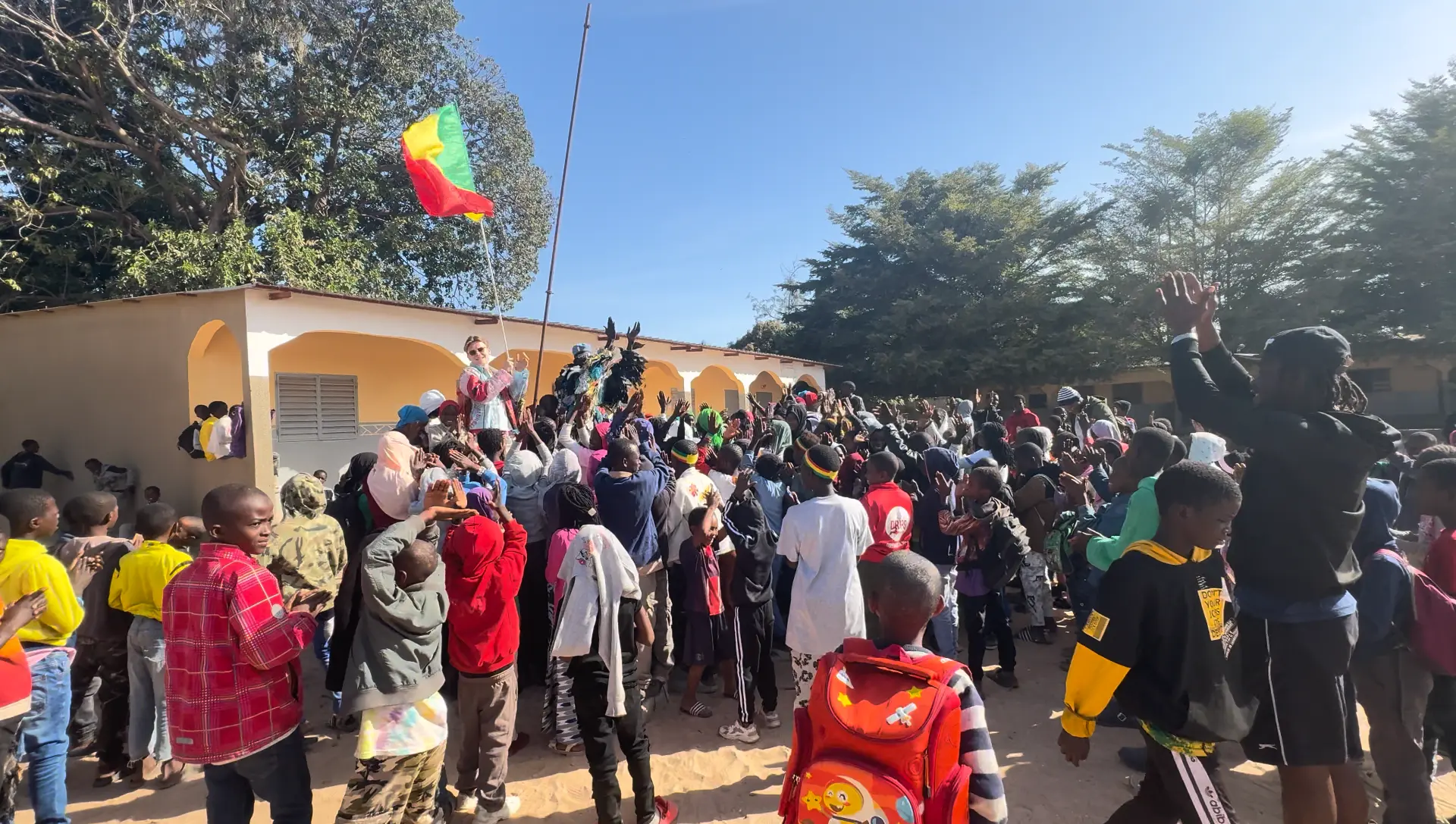
Walking the Tour de Senegal through rural villages. One hundred kilometres through the south of Senegal: the point was never to be seen, but to create encounters. In January, Niklas returned to continue work with Moudou and to launch his own platform, Sustainable Hero. Together, they continued Moudou’s Tour de Senegal, a project that began in 2021 with the goal of bringing the Plastic Man beyond Dakar and into the country at large. Moudou had once walked 270 kilometers alone over 10 days. Later, he and Niklas walked 210 kilometers together. For the next stage, they chose a shorter but more intentional route: 100 kilometers through the south of Senegal, moving through rural villages where they could spend more time with people instead of simply passing through.
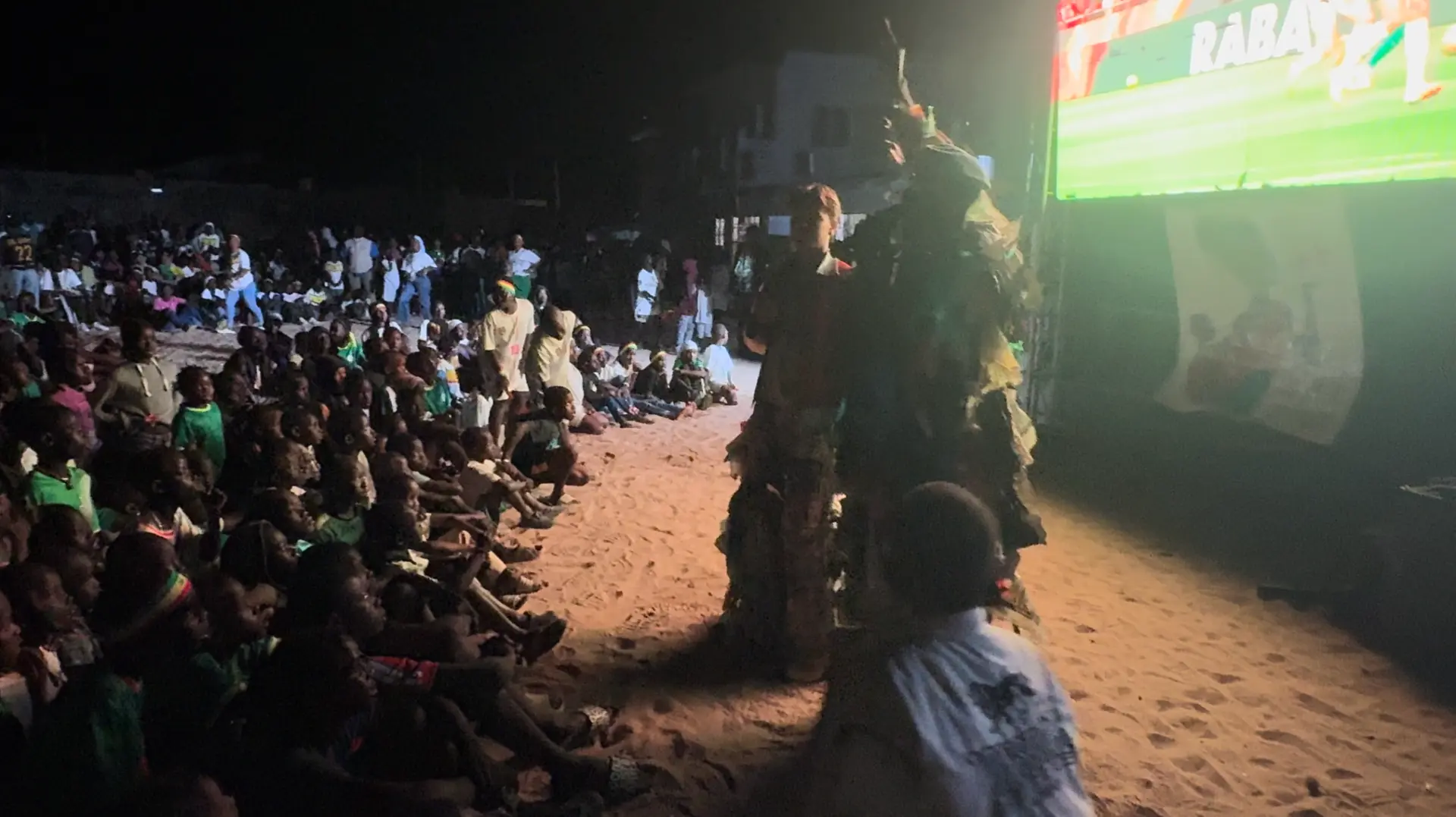
They visited schools, classrooms, local chiefs, mayors, military representatives, organizations, and communities. The point was not simply to be seen. The point was to create encounters.
In schools, they asked children how long they thought a plastic bag would remain in nature. Some guessed two years. Some guessed five. Then came the answer: hundreds of years. They explained that burning plastic was not a solution. They talked about consequences. They used the costume to hold attention, but the real work was in the conversation that followed.
It is easy to romanticize this kind of journey from far away. A young man walking through villages with an environmental hero sounds cinematic, almost mythic. But in practice, it is exhausting and complicated. It means heat, uncertainty, logistics, money problems, cultural misunderstandings, and the burden of trying to do something meaningful in places where people may have far more immediate worries than plastic pollution.
That is part of what moved Niklas about Moudou.
Moudou has a family. He has children. He has monthly financial pressure. He has the same ordinary human concerns that shape everyone’s life. Yet he chose to worry about plastic pollution and the environment as his central concern. That decision is not small. It is not symbolic. It costs something.
At one point, Moudou had achieved what might have looked like stability. After years of work, he was connected to the Ministry of Environment. He had a salary. He had institutional recognition. For many activists, that would have been the dream. But according to Niklas, Moudou quit when he was told he could not speak freely on TikTok about certain plastic industries. At the time, he did not even have the large following he has today. He could have stayed quiet. He could have kept the salary. He could have accepted the compromise.
He did not.
That decision reveals something essential about him. Moudou is not simply a man who wears plastic to attract attention. He is a man who refuses to let attention become obedience. He does not want to be turned into a harmless symbol. He wants the costume to keep speaking, even when the truth becomes inconvenient.
Niklas seems fascinated by this courage, almost baffled by it. When he asks Moudou what motivated him to begin, the answers sound deceptively simple. Moudou remembers being in the military and seeing trees cut down, leaving birds without a place to go. He remembers selling products in the market and seeing everything wrapped in plastic, surrounded by trash. Somebody had to do something.
For Niklas, raised in a world where activism often arrives with theories, campaigns, institutional language, and strategic plans, that answer may feel too simple at first. But maybe that is the point. Moudou’s life seems to have turned on the oldest form of responsibility: he saw something wrong and could not continue as if he had not seen it.
That is also the turning point in Niklas’s story.
He sees Moudou seeing the problem. Then he cannot unsee it either.
What makes this interview compelling is that beneath the environmental story is another story entirely. It is the story of a young man trying to become himself.
Niklas is not presented as a finished person. That is what gives the piece its emotional strength. He is still in motion. He is studying in the Netherlands. His home is Switzerland. His heart seems partly in Senegal. He works to fund his trips. He admits he has debt and needs to earn money again. He is building a platform but still figuring out how to sustain the work. He has become an activist of sorts, even creating his own plastic costume, but he is also still learning what that means.
There is something very honest in that.
A lot of stories about young changemakers flatten them into inspiration. They become neat examples of courage, purpose, and global citizenship. But real purpose is rarely neat when it first appears. It often arrives as confusion. It interrupts plans. It costs money. It creates questions from family and friends. It pulls you between countries. It makes ordinary life harder to explain.
Niklas went to Senegal to surf. Then he went back to film wrestling. Then he stayed seven months with the Plastic Man. Then he returned again to continue the work. Each return seems less accidental than the last. Senegal became not a destination but a mirror. In it, he saw parts of himself he might not have found at home.
He found that he could live in discomfort. He found that language could change a relationship to a place. He found that the neighborhoods people fear can also be full of friendship. He found that storytelling can become service. He found that environmental work is not only about the environment. It is about dignity, education, courage, and whether a person is willing to be uncomfortable long enough to be useful.
He also found that joy and hardship can exist in the same street.
That may be one of the hardest lessons for someone coming from a wealthy country. Poverty is often described from outside in terms of what is missing. Senegal showed him something more complex. There were material struggles, yes. There were structural issues, yes. There was pollution, inequality, and lack of infrastructure. But there was also happiness, humor, generosity, social connection, and welcome. The people he met were not symbols of need. They were people living full lives inside complicated circumstances.
That realization matters because it prevents the story from becoming simplistic. The plastic problem is urgent, but Senegal is not reducible to pollution. Moudou is not reducible to activism. Niklas is not reducible to outsider guilt. The real story lives in the relationship between all three: a country, a man who has dedicated his life to protecting it, and a younger man who found himself changed by both.
There is also a generational question running through the interview. What does it mean to grow up on a planet already damaged by previous choices? For Niklas’s generation, environmental crisis is not a future warning. It is the backdrop of adulthood. Climate change, pollution, and ecological loss are not abstract subjects. They are inherited conditions.
But inheritance alone does not create purpose. Many young people know the problems are real and still feel paralyzed by their size. They are told to care, but not always shown how to act. They are surrounded by information, but information can become its own form of helplessness.
Moudou offered Niklas something different. Not a theory. A practice.
Walk. Speak. Show up. Repeat. Make the invisible visible. Do not wait for the perfect organization, the perfect funding, or the perfect moment. Begin where you are, with what you have, and let the work become a life.
That model seems to have affected Niklas deeply. He is not only documenting Moudou. He is learning from him how to stand inside a problem without being crushed by it.
The costume itself becomes a kind of symbol for both men. For Moudou, it is a weapon of awareness. For Niklas, creating his own version, Lom Plastic Jr., becomes a step into the work rather than just around it. He is no longer only behind the camera. He is now inside the image. He has become part of the performance, part of the message, and part of the risk.
There is vulnerability in that. Wearing a costume made of trash is not cool in the ordinary sense. It invites laughter, confusion, attention, and judgment. But it also forces the wearer to surrender a certain kind of ego. You cannot dress as the problem and still pretend to be above it.
That may be one of the quiet transformations in Niklas’s story. Senegal did not just give him a cause. It loosened his relationship to himself. It allowed him to become stranger, braver, less polished, more open.
By the end of the interview, he is not claiming to have solved anything. That is important. The plastic is still there. The infrastructure challenges remain. Education takes time. Government support is uneven. Environmental events still hand out plastic bottles in plastic goodie bags. Contradictions remain everywhere.
But something has moved.
A young man from Zurich now sees plastic differently. He sees Senegal differently. He sees himself differently. A man who had already spent nearly 20 years fighting for his country’s environment now has a younger ally willing to walk beside him. A story that began as a surf trip has become a record of transformation.
The most human part of the whole thing may be that Niklas did not set out to become this version of himself. He followed interest, then friendship, then responsibility. He let one experience lead to another until the path became visible behind him.
That is often how growing up really happens. Not in one decision, but in a series of encounters that slowly make old versions of yourself impossible to return to.
In Senegal, Niklas found waves, wrestling, language, friendship, danger, joy, and plastic. He found a man dressed in waste who had somehow turned refusal into a life’s work. He found a country that did not simplify itself for him. He found a problem he could no longer leave on the ground.
And somewhere along the road, walking beside the Plastic Man through villages, classrooms, and heat, he began to find himself.